Danske Bank · 2025

FX Sales

Dashboard

Designing a unified sales workspace for Foreign Exchange advisors, bringing together customer data, trading activity, exposure, and risk signals that previously lived across 8–10 disconnected tools.

Role
Lead Product Designer
Company
Danske Bank · Copenhagen
Scope
End-to-end design · Research
Status
Live — actively iterated
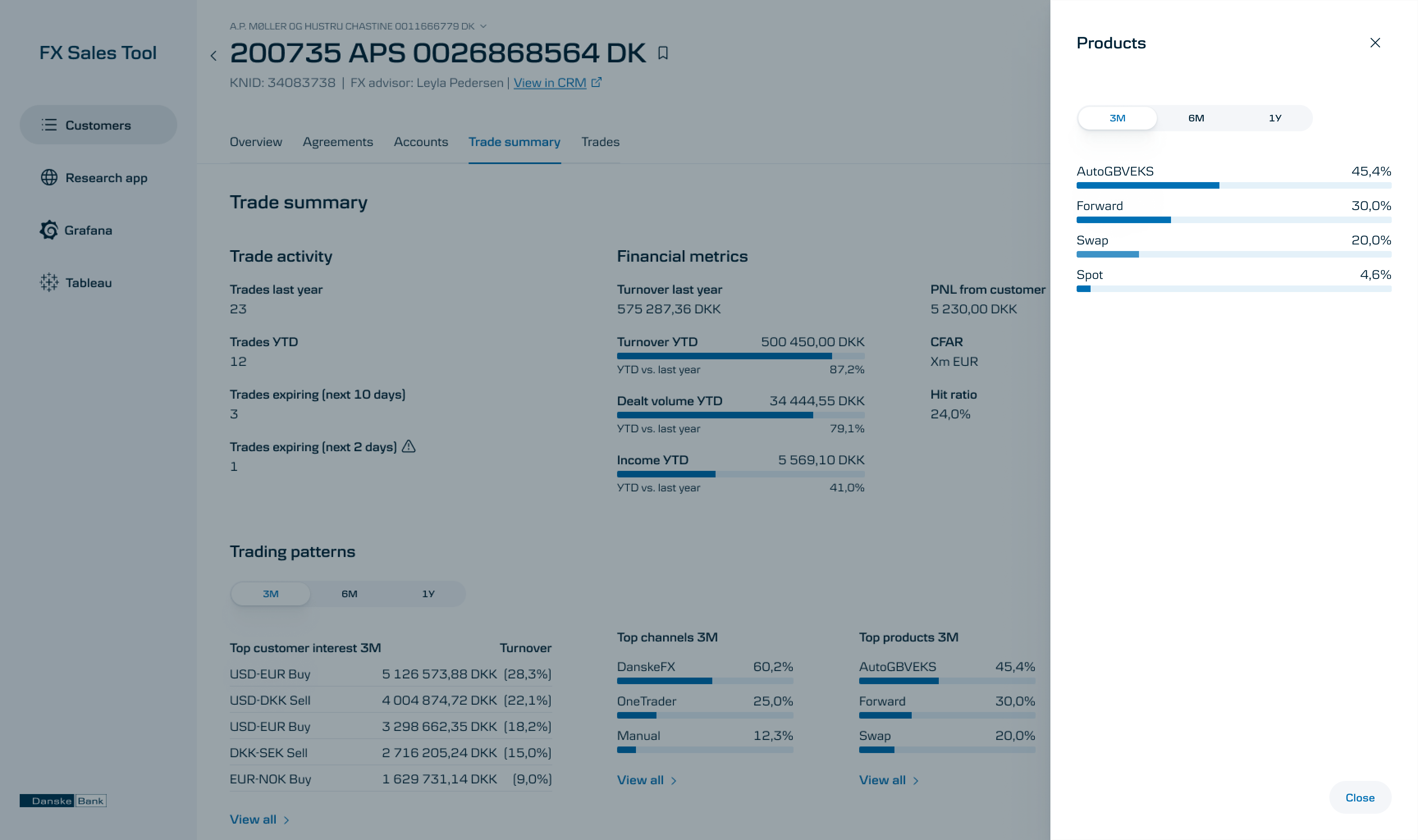
FX Sales Dashboard - Trade Summary
81
Tools replaced by a single unified workspace
10+
Scattered data categories consolidated into one advisor view
Multi-market
Deployed across DK, SE, FI, NO
01

The problem

FX Sales advisors support business customers with foreign exchange products: spot trades, forwards, options, and hedging strategies. To prepare for customer conversations and make recommendations, advisors need a clear picture of a customer's trading history, exposure, mandates, margins, and upcoming risks — often while on a live call.

Before this initiative, that picture had to be assembled manually from a fragmented ecosystem of CRM systems, trading platforms, separate dashboards for balances and exposure, and Excel sheets for tracking interests and calculations. No single tool gave advisors a reliable overview of a customer or customer group.

The result was significant cognitive overhead. Constant context switching, manual data reconciliation under time pressure, and limited ability to prioritise customers or spot opportunities quickly. The problem was compounded by the domain: FX sales operates in a high-value, risk-sensitive environment where even small blind spots can have material financial consequences.
02

Who I designed for

The tool was designed for FX Sales advisors spanning SME, large corporate, and institutional segments across multiple Nordic markets. Each advisor typically managed portfolios of dozens to hundreds of business customers, often with complex hierarchies and multiple legal entities, making prioritisation and overview critical to their daily work.

User type #1
FX sales advisor
The primary user. Manages a large portfolio of business customers. Needs fast, scannable overviews of trading activity, exposure, and risk — especially during live customer conversations.
User type #2
Relationship manager
Broader customer relationship focus. Needs enough FX context to spot opportunities and escalate to specialists. Values clarity over depth.
User type #3
Team lead / Senior Advisor
Oversees customer portfolios across a team. Needs group-level views and the ability to identify patterns, risks, and priorities across a wider book of business.
03

How I approached it

I joined the project at discovery phase and led the design end-to-end. Rather than working from a traditional requirements document, I established a continuous feedback loop with advisors, keeping them involved from early concepts through to live iteration.

Working within Danske Bank's Sapphire design system, I extended existing components where needed to accommodate the specific demands of a financial sales context: data-dense layouts, multi-level customer hierarchies, and fast scanning under pressure.

01
Discovery
Qualitative interviews with FX Sales advisors across Denmark and Finland. Sessions focused on daily workflows, tools used before and during calls, and what meaningful support would actually look like in a live sales context.
02
Design
End-to-end information architecture and UI design in Figma. The core challenge was deciding what must be immediately visible, what belongs behind progressive disclosure, and what should link out to existing specialist tools.
03
Delivery
Continuous feedback loops with advisors throughout the build. Changes were prioritised based on real usage signals, adjusting UI density, terminology, and component behaviour across phases.
04

The hard part

The fundamental tension was building a tool that could serve advisors during live customer calls — where speed, scannability, and confidence are non-negotiable — without oversimplifying a genuinely complex financial domain.

The information challenge was equally significant. Data lived across multiple systems with different owners, dependencies, and technical constraints. Deciding what to surface, what to defer, and what to link out to required close collaboration with engineering and analytics, and a clear hierarchy of information that could scale.

A second challenge was cultural. FX sales workflows had long been propped up by Excel and workarounds. Replacing ingrained habits required advisors to trust the tool — which meant involving them early and continuously rather than presenting a finished solution.

"Advisors weren't asking for more data. They were asking for better structure, prioritisation, and visibility. The design challenge was making that feel effortless in the middle of a customer call."

05 — Solution

The final product

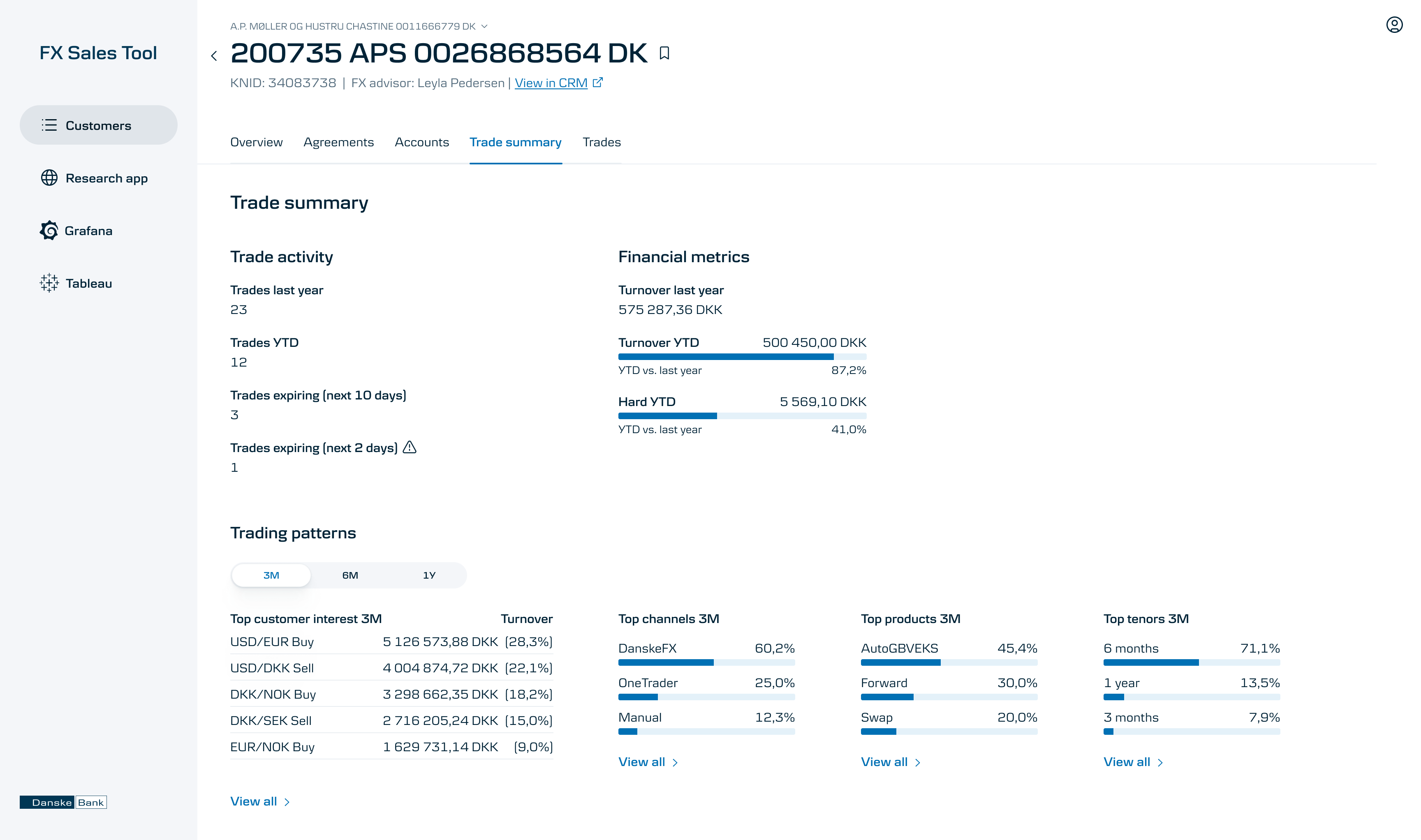
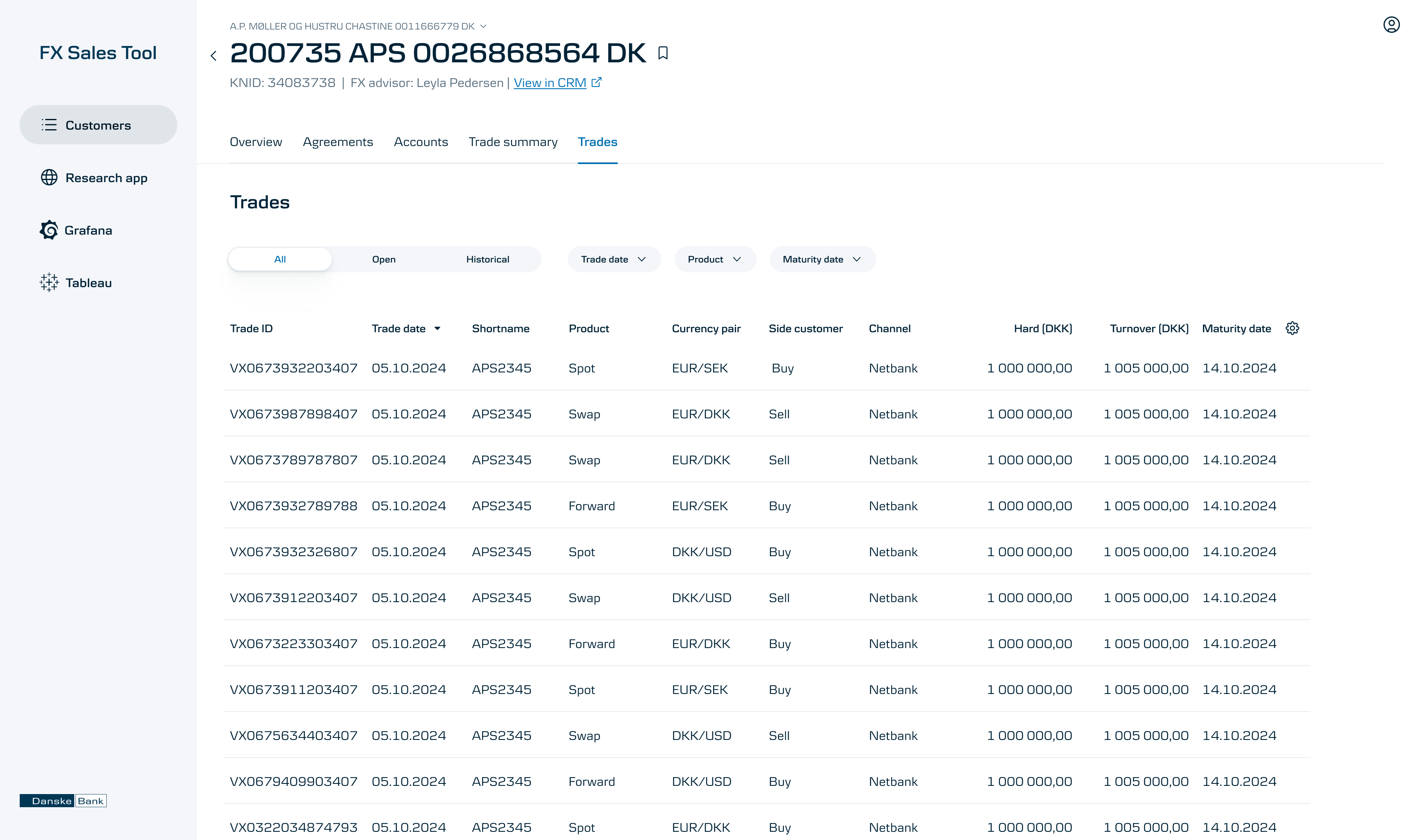
A unified FX Sales workspace acting as a central hub — bringing together customer and group-level overviews, trading activity, exposure and risk indicators, and sales signals in one place. Rather than replacing all existing systems, the tool focused on orchestration: helping advisors know where to look and when to act.

06

What I learned

Clarity is a competitive advantage
In a complex financial domain, the ability to present the right information clearly — not exhaustively — is itself a meaningful differentiator.
Excel is a signal, not a solution
Widespread spreadsheet use pointed to unmet product needs, not user preference. Treating it as a gap to design into, rather than a habit to replace, shaped the entire approach.
Live conversations change the design bar
Designing for a tool used during calls meant ruthless prioritisation. Every element had to earn its place at a much higher threshold than a typical B2B product.
Advisor involvement is adoption
Because advisors were engaged throughout rather than presented with a finished product, the tool addressed concrete, long-standing problems they recognised as their own. That is a stronger adoption signal than any metric.
Next case study
FX Trading Automation